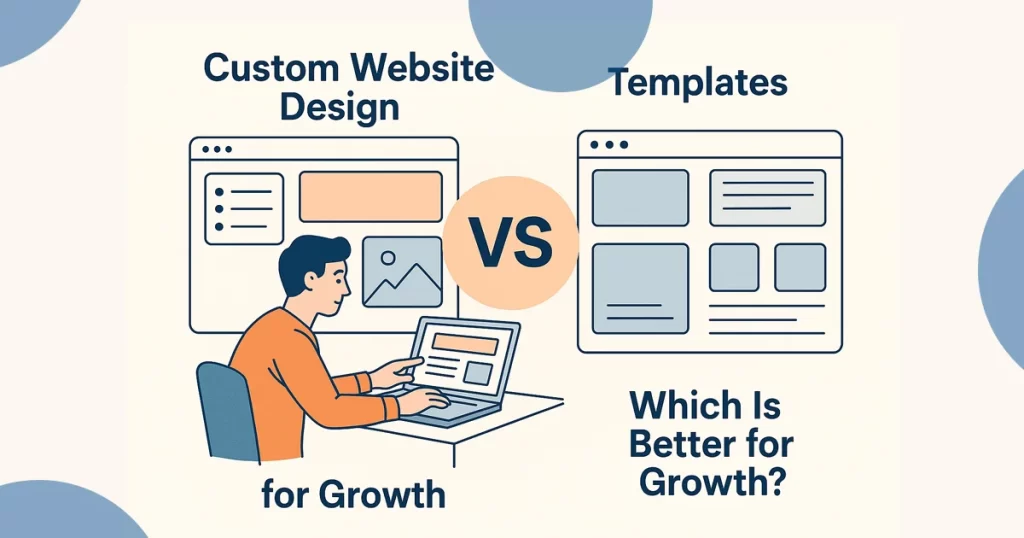
Do you want a website that truly reflects your brand and drives growth, or are you looking for a quick, budget-friendly solution? The debate between custom website design and templates is one that every business owner faces. As you consider your digital presence, the decision to go custom or use a template could determine the success of your online presence, user experience, and ultimately your revenue.
Imagine this: You’re a business owner with a limited budget, but you want your website to stand out in a crowded market. Do you settle for a template that’s easy to launch but limits your brand’s uniqueness? Or do you invest in a custom-designed site that might cost more but can potentially boost conversions and customer loyalty?
In this post, we’ll explore both options in detail—helping you weigh the pros and cons to make the best decision for your business’s long-term growth.
1. What Is Custom Website Design?
A custom website design involves creating a website from scratch, tailored specifically to the unique needs, goals, and branding of your business. It is usually created by professional web designers or agencies, and each element—such as layout, functionality, and content—can be fully customized to reflect your brand’s identity.
Pro Tip: Custom websites are perfect for businesses that require specific functionalities, unique aesthetics, or advanced user interactions that templates can’t easily offer.
Example: A luxury jewelry brand might need a custom website to showcase their high-end products with sophisticated animations, high-resolution imagery, and a unique layout that aligns with their exclusive brand. A template simply can’t provide the same level of customization.
2. What Is a Template-Based Website Design?
A template-based website is built using pre-designed layouts and elements. Many website builders like WordPress, Wix, and Shopify offer templates that can be quickly customized with your content. These templates are generally faster and less expensive to implement but are limited by the pre-built structure.
Pro Tip: Templates are ideal for businesses with a tight budget or those that need a simple website quickly. They’re also great for small businesses or personal websites that don’t require complex functionalities.
Example: A small local coffee shop may choose a template to build a website quickly, showcasing their menu, location, and hours. Since the website doesn’t need complex features, a template is a cost-effective solution.
3. How Do Custom Websites Benefit Brand Identity and User Experience?
One of the most significant advantages of a custom website design is the ability to reflect your brand’s personality and values. Unlike templates, which have preset structures, a custom site allows you to design every detail—from the color scheme to the typography—to align with your brand identity.
Pro Tip: A strong, cohesive brand identity on your website builds trust with visitors and helps differentiate you from your competitors. Custom designs allow for creative freedom in storytelling through design.
Case Study: A high-end restaurant in Lahore invested in a custom website design that mirrored their luxurious ambiance. The design featured an elegant, sophisticated layout that aligned with their fine dining experience, which ultimately improved user engagement and online reservations.
For user experience (UX), custom websites allow for greater control over site navigation, interactions, and load speed. When built properly, this translates into an intuitive experience that keeps users on your site longer, improving conversion rates.
4. How Fast Can You Launch with Templates?
If speed to market is a priority for you, template-based websites offer a significant advantage. Since the structure is already in place, you can launch your site in a matter of hours or days, depending on the level of customization you require. This makes templates a perfect choice for businesses that need to get their site up quickly.
Pro Tip: Templates allow for faster implementation without compromising too much on quality. Just make sure you choose a template that fits your needs and is responsive on all devices.
Example: A startup launching a new product may opt for a template to quickly create an online store. The faster they go live, the sooner they can begin generating leads and making sales.
5. Which Option Is More Cost-Effective for Small Businesses?
The cost factor is one of the biggest differences between custom websites and templates. A custom design generally requires a larger upfront investment due to the time and expertise required to develop a unique site. In contrast, templates are far more affordable, especially when considering they can be purchased for a one-time fee or with a subscription.
Pro Tip: While templates are more cost-effective in the short term, investing in a custom design can result in higher long-term returns if your website becomes a key driver for business growth.
Real-World Insight: A small business in Multan opted for a template when first starting out. However, as the business grew, they realized that the limitations of the template were hindering their ability to scale. They eventually made the switch to a custom site, which allowed for more robust features and better optimization.
6. How Do SEO and Performance Differ Between Custom and Template Sites?
SEO and site performance are crucial for online visibility. While both custom websites and templates can be optimized for SEO, custom websites offer a distinct advantage in terms of performance and flexibility. Since custom sites are built from the ground up, they can be optimized for speed, responsive design, and keyword targeting based on your specific audience.
Pro Tip: With templates, SEO performance can be hindered if the template is not designed with SEO in mind. Custom websites, on the other hand, can be developed with SEO best practices in mind, ensuring better organic search visibility.
Example: A digital marketing agency in Multan initially used a template for their website. Over time, they realized that despite their content efforts, the site’s structure wasn’t ideal for SEO. After migrating to a custom-built site, they saw a 35% increase in organic traffic within three months.
7. Which Option Offers More Flexibility and Scalability?
As your business grows, so should your website. Custom websites offer superior flexibility, allowing you to add features, integrations, and custom functionalities as your needs evolve. This scalability is crucial if you anticipate significant growth or have complex business processes that need to be reflected on your site.
Pro Tip: If you’re planning to scale your business in the future, opting for a custom-built website will save you from having to rebuild or redesign your site later on.
Case Study: A small online retailer using a template found it difficult to add a subscription model or integrate with third-party apps as their business grew. After migrating to a custom site, they were able to seamlessly incorporate new features, leading to a 20% increase in revenue.
8. Which One Provides Better Security?
Security should never be overlooked when choosing a website design. Custom websites allow developers to implement tailored security measures, reducing the risk of vulnerabilities. Templates, especially those built on website builders, may rely on default security protocols, which can leave your site open to attacks if not properly configured.
Pro Tip: Ensure that any template you use comes with strong security features and updates. For highly sensitive businesses, a custom website design will offer more control over data protection.
Conclusion
Choosing between a custom website design and a template-based website comes down to your business goals, budget, and growth plans. If you’re looking for a personalized, high-performance website that grows with your business, a custom design will provide the flexibility and uniqueness you need. However, if you need a quick, cost-effective solution that meets basic needs, templates can be a good starting point.
No matter what you choose, remember that your website is a critical part of your business strategy. Whether you opt for a custom-built website or a template, ensure that it’s optimized for performance, user experience, and long-term growth.
Next steps: Ready to make your website work for your business? Reach out to a professional web design team to explore the best options for your business’s digital future.
FAQ Section
Q1: Can I switch from a template website to a custom design later?
A1: Yes, you can transition from a template to a custom design as your business grows. However, it’s essential to plan this transition carefully to avoid losing traffic or SEO rankings.
Q2: How long does it take to build a custom website?
A2: Custom websites typically take 4-8 weeks to design and develop, depending on the complexity and features needed. It’s a more involved process than using a template, but the results are often worth the wait.
Q3: Are custom websites more secure than templates?
A3: Custom websites can offer more tailored security features, reducing the risk of vulnerabilities. Templates might have default security protocols, but they may not be as comprehensive.
Q4: Do templates work well for e-commerce businesses?
A4: Templates can work well for e-commerce sites, but they often come with limitations in customization and scalability. If you plan on scaling your online store, a custom design may be more suitable for future growth.
Q5: How much more expensive is a custom website compared to a template?
A5: The cost of a custom website is typically higher, with prices ranging from $3,000 to $10,000 or more, depending on features and complexity. Templates are generally less expensive, with prices ranging from free to $100+.
Q6: Can a custom website be SEO optimized better than a template?
A6: Yes, custom websites can be designed with SEO best practices in mind from the start, offering better optimization for speed, structure, and targeted keywords compared to templates.